

It was one of those weeks where every headline landed heavier than the last. Anthropic posted a $30 billion annualized revenue run rate — a number that seemed made up until the Bloomberg reporting checked out. A few months ago they were at $14 billion. Now $30 billion, with 3.5 gigawatts of committed compute through 2031 courtesy of a recent Google deal.
Let that sink in: a company that was considered the “laggard” eighteen months ago is now arguably the hottest enterprise AI company on the planet.
Claude Mythos & Project Glasswing
Anthropic also debuted Claude Mythos — their most capable model yet — alongside Project Glasswing, a security-focused initiative that represents a step function change in cybersecurity capabilities. Mythos is reportedly so effective at discovering zero-day exploits that Anthropic is giving preview access to large tech companies and roughly 40 additional organizations building software and maintaining open source projects, so they can patch vulnerabilities before the model is widely available.
Our hot take: It wouldn’t surprise us if running a Mythos-grade security scan becomes a compliance requirement within the next 18 months. And if it does, model availability will likely become gated and premium-priced — we haven’t seen the labs restrict access like traditional SaaS feature tiers yet, but this feels like the kind of capability that changes that.
OpenAI’s Enterprise Problem (And Why It Might Not Be Their Fault)
Here’s the thesis Quinn has been building: OpenAI may be contractually handcuffed in the enterprise.
When OpenAI signed its deal with Microsoft several years ago, Microsoft became the only hyperscaler that could host OpenAI models. Fast forward to today and the competitive landscape has completely inverted. Anthropic signed deals with Amazon, and now every major cloud has Claude in its lineup. AWS sellers push Claude on Bedrock. GCP reps sell Claude on Vertex. Even Microsoft sellers can offer Claude on Azure Foundry.
Meanwhile, OpenAI’s only enterprise advocates are Microsoft reps — who are incentivized to sell a buffet of models, not just OpenAI. The result? Tens of thousands of enterprise sellers at AWS, GCP, and Azure are all effectively selling against OpenAI every single day. As Quinn put it: “When you walk into an account, you’re literally like — I will sell you anything but OpenAI. Because I can’t.”
Doom added some color: most of OpenAI’s go-to-market team are former AWS startup sellers and account managers. They know the motion, but they’re now the only sales force swimming against the current.
Until OpenAI gets its stateful platform (their equivalent of Claude Code and Cowork) running on other hyperscalers, the enterprise distribution problem is real.
Meta Launches Muse Spark
Meta Superintelligence Labs announced Muse Spark — the first frontier model built on their completely rebuilt AI stack. Alexander Wang shared on X: “Nine months ago we rebuilt our AI stack from scratch. New infrastructure, new architecture, new data pipelines. Muse Spark is the result.”
Quinn gave it a spin for image generation and wasn’t blown away, but the signal is clear: Meta is spending billions, the stack is new, and the competition isn’t slowing down.
Are Tokens the New Cloud?

This was the big question of the week, prompted by a16z’s excellent “Charts of the Week” on the SaaSpocalypse. The data from the Jefferies CIO survey is striking:
In August 2024, fewer than 10% of companies were spending 5% or more of their tech budget on AI. By January 2026, that figure jumped to over 60%. And the breakdown across spending tiers — 5-10%, 10-15%, and 15%+ — shows that this isn’t just dipping a toe. Companies with billion-dollar tech budgets are now committing meaningful percentages to AI tokens and infrastructure.
As Quinn put it: “Doom, are tokens the new cloud?”
Doom’s answer: “I mean, this says it is.”
The SaaSpocalypse: Nuance Over Narrative
We’re not on the SaaS apocalypse bandwagon — but we’re not ignoring the data either.
The a16z charts break down year-over-year spend changes among the largest AI-adopting companies. HubSpot is the clear winner, with the highest median and average growth in the panel. Figma, Box, Cloudflare, Datadog, and Semrush also posted strong 25%+ growth among the biggest spenders.
On the other side: Dropbox is flat-to-negative. Atlassian is down 21%. Asana is down 45%.
There was also a telling signal: 71% of CIOs expect to cut systems integrators to fund AI or cybersecurity. But zero respondents planned to cut cybersecurity budgets. Zero.
Doom made the observation that the OG incumbents — your Salesforces, your tightly-integrated stacks — are better positioned than the mid-tier point solutions. His team just added Salesforce seats. But he’s hungry for the Cowork MCP integration so non-engineers on his team can leverage Claude directly against their CRM data.
Quinn’s take: SaaS won’t die, but procurement is going to come in hard. Expect seat count pressure, base-plan downgrades, and revenue headwinds for any platform that isn’t going all-in on AI.
AWS Trainium Backlog
A quick signal worth noting: AWS CEO Matt Garman mentioned that all currently active Trainium infrastructure is already spoken for — and future capacity is earmarked as well. For context, Trainium is Amazon’s custom silicon designed for deep learning workloads with strong price-performance. It’s now also handling inference, which overlaps with their Inferentia chip. The backlog is likely multi-billion dollars, driven heavily by Anthropic’s demand.
As Doom put it: “Long story short — buy your call options for Amazon.”
Builder Corner: What We’ve Been Building
Quinn: Set up CI/CD pipelines pushing from GitHub to a hyperscaler running database, container, and gen AI environments — no manual laptop auth needed. Also configured Cowork scheduled tasks to process podcast transcripts and generate research prep docs using Opus 4.6. Created and presented an Enterprise Security Stack presentation (now on YouTube). Next up: a new category presentation every week.
Doom: Been using Dune Analytics with MCP integration to query on-chain data dashboards built by data scientists, then asking Claude to go deeper on unfamiliar metrics. The analysis comes back confident — sometimes too confident — so everything gets annotated “Hey, this is from Claude” before it goes to the team.
Quinn’s tip: Use Apple’s voice memos for quick brain dumps. The built-in Whisper transcription is rough, but paste it into an LLM and it cleans up instantly. Great way to capture authentic voice as a writing starting point.
Fringe Lines drops weekly. Subscribe so you don’t miss the next one. And if something hit different this week, tell us in the comments — we read every one. — Quinn & Doom
4/ Recommended Tables & Nano Banana Pro Image Prompts
Recommended Tables
Table A — SaaS Spend Winners & Losers Among Large AI Adopters
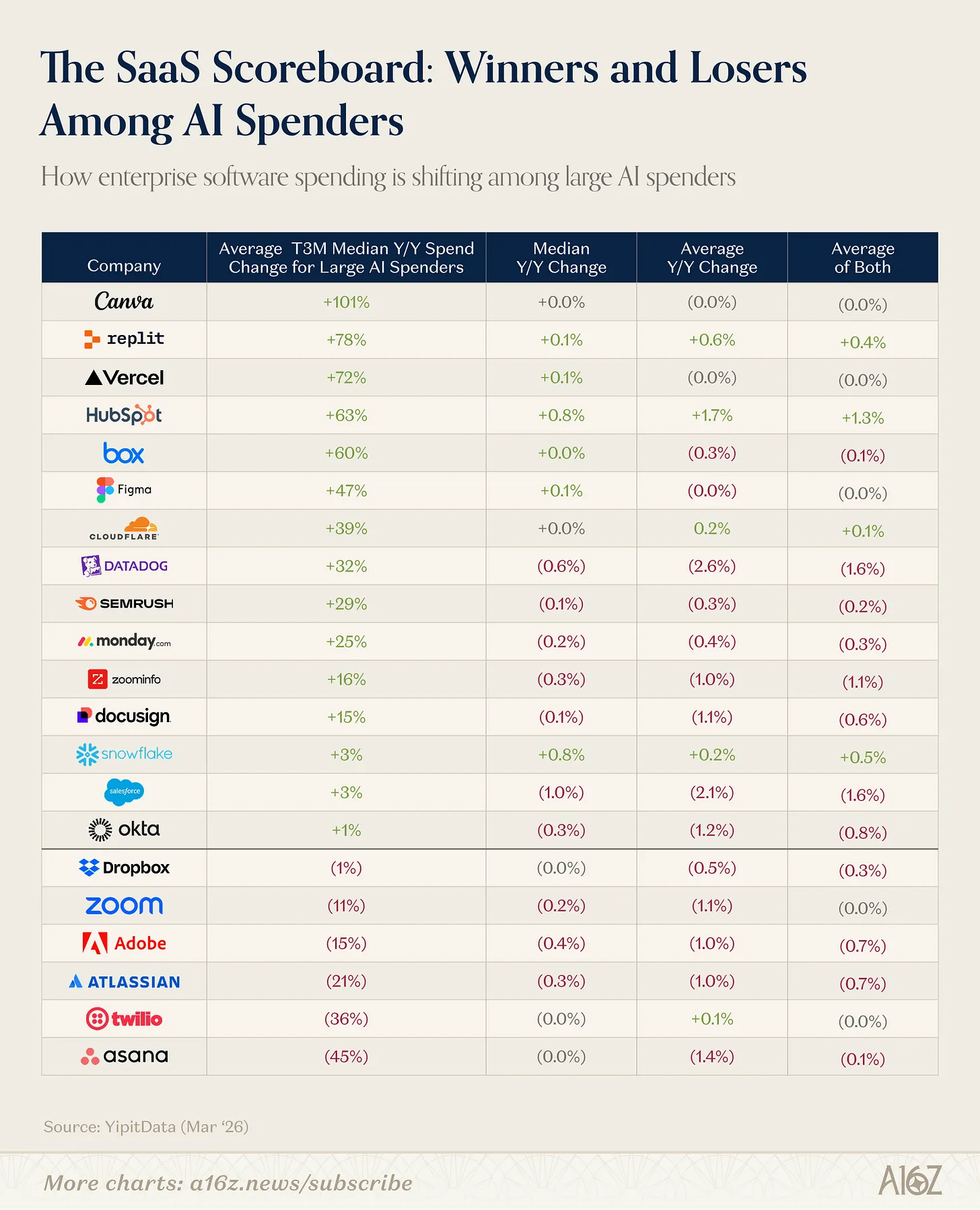
Table B — AI Share of Enterprise Tech Budgets Over Time
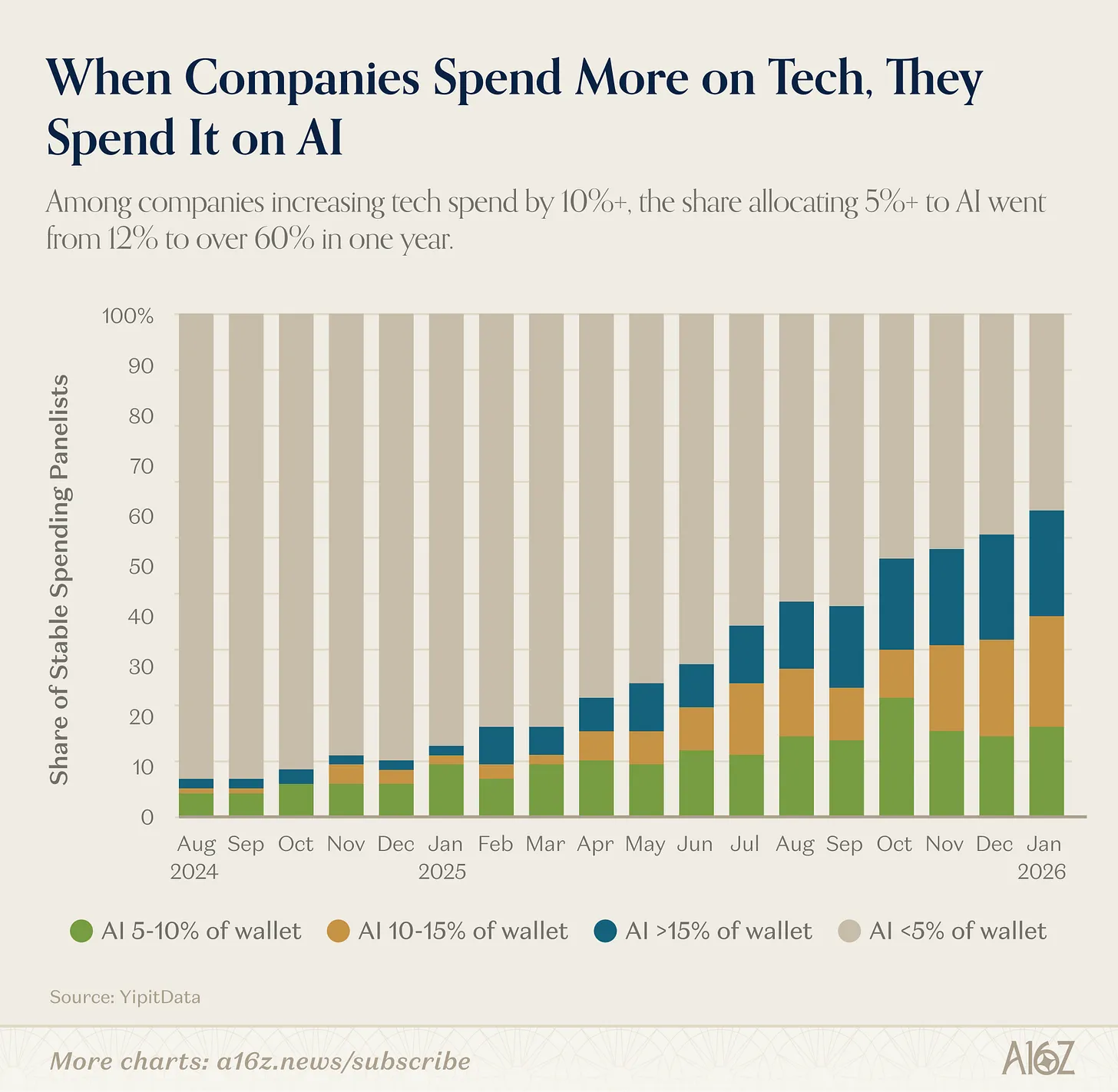
Source: a16z / Jefferies CIO Survey panel of large AI spenders