

The moat moved. It shifted from “can you build it?” to the three things code generation cannot solve for right now: distribution, trust, and taste. Everything else this week, from robotic AI SDRs face-planting to Salesforce’s headless demise becoming the fulfillment of the CRM vision. When execution goes to zero, value shifts to what is scarce.
Being a Unicorn is no longer good enough; you gotta think bigger
Let’s start with talent, because talent tells you where the perceived value went. The highest-agency builders, the people shipping the interesting stuff right now, will not join a 1-billion-dollar startup. A unicorn is a participation trophy. You need line of sight to 10, 20, 100 billion, or the best people would rather do their own thing. RSUs and tender offers do not move someone who can spin up a company in a weekend.
The flip side of that is the founder pool got older and wider. The 40-something second-time founder, the profile VCs used to pass on, is now the profile that wins, because agency plus cheap tooling beats a thin resume and a demo. Anyone with enough agency can go build the thing. That is the good news, and it is also the problem, because it is true for everyone at once.
The leaky RevOps bucket problem
Building is now easy, even if shipping is harder. Selling is still brutal. And churn is quietly killing the companies that figured out the first two.
You get the momentum, you land the logos, and then the customer churns 90 days later. Hard-earned revenue leaks out the bottom as fast as it comes in the top; you burn cash chasing net-new to replace what you lost, and you never reach profitability. More startups exist than ever, which means the scarce thing is not another product. It is distribution, it is trust, and it is product velocity, which is exhausting. VCs still want the 100x exits, not a tidy 10x, so the pressure to grow never lets up.
Token maxing is out, and Routing is the cool kid now
For a while, the move Big Tech wanted from its employees was token maxing, throwing the biggest frontier model at everything, driving up leaderboards, and paying for it. The unconstrained era is ending with applause from CFOs across the enterprise. The interesting question now is not “how much can we spend,” it is “what is the right model to execute this specific task.”
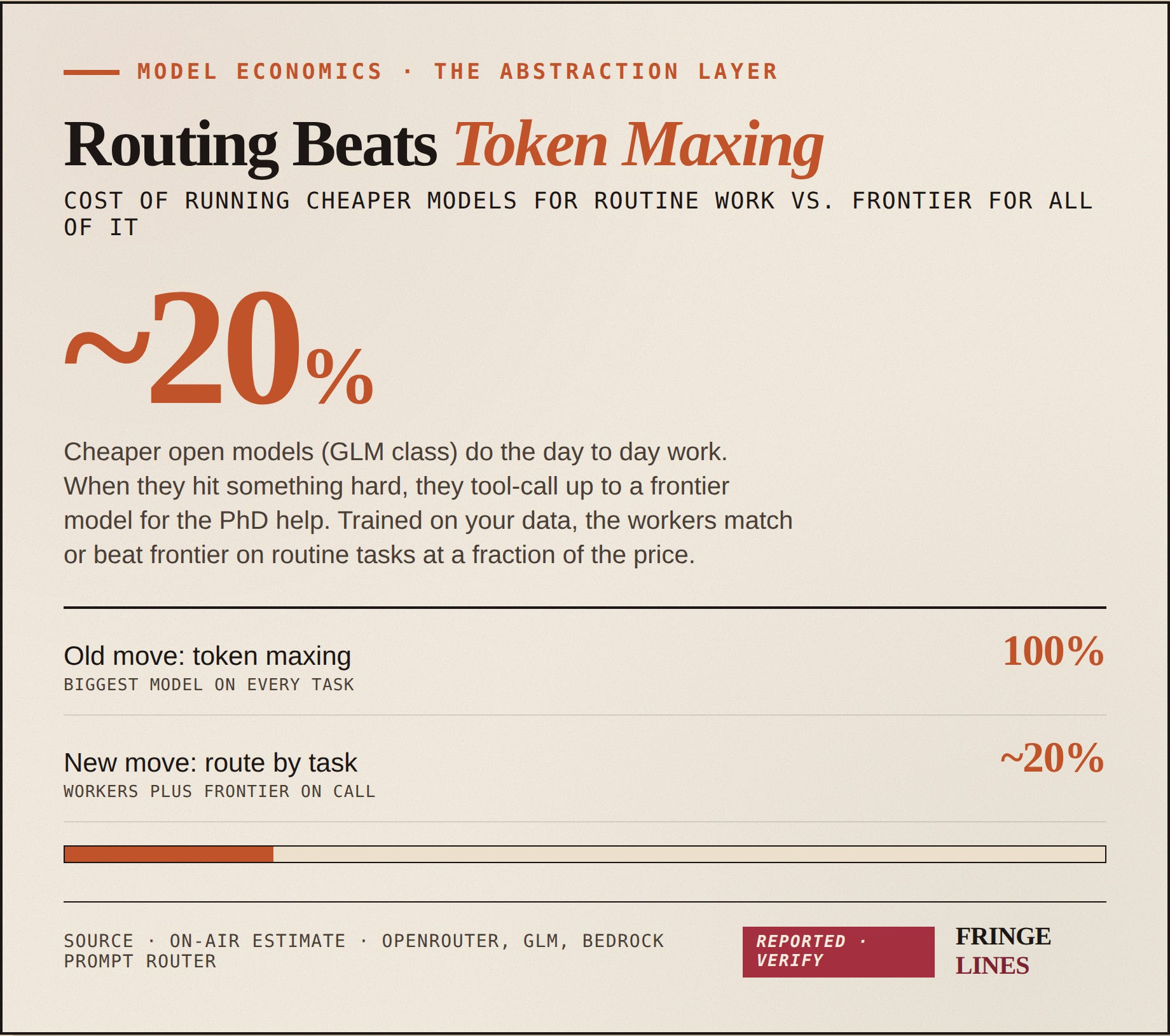
The pattern taking shape is that cheaper open models like the GLM family do the day-to-day work, and when they hit something hard, they make a call to a smarter frontier model, Opus or GPT 5.6 Sol, for the PhD-level help. Trained on your company data, the cheaper workers perform as well or better on the routine stuff at a fraction of the price, reportedly around 20 percent of the cost.OpenRouter sits in the middle of this and has gotten noticeably more valuable in the last three months than it looked before.
Here is the part that surprises us. Amazon Bedrock and Azure sit on catalogs of serverless, token-based models, exactly the right place to build a smart routing layer that reads the prompt and sends it to the right model, with guardrails and evaluations attached. Bedrock has the beginnings of this with Prompt Router. Neither has fully run at it. The incentive is the tell: a good router means the customer spends less per call, so the hyperscaler bills less per call. Except that is the Jevons paradox trap. Make tokens cheaper, and people do not spend less; they spread tokens across more use cases, like peanut butter, and total spend climbs. The lab that builds the best router does not lose the bill. It captures the next 10 use cases the old price tag was blocking.
The AI SDR autopsy
Nothing this year makes the “keep a human in the loop” case better than the autonomous sales development rep.
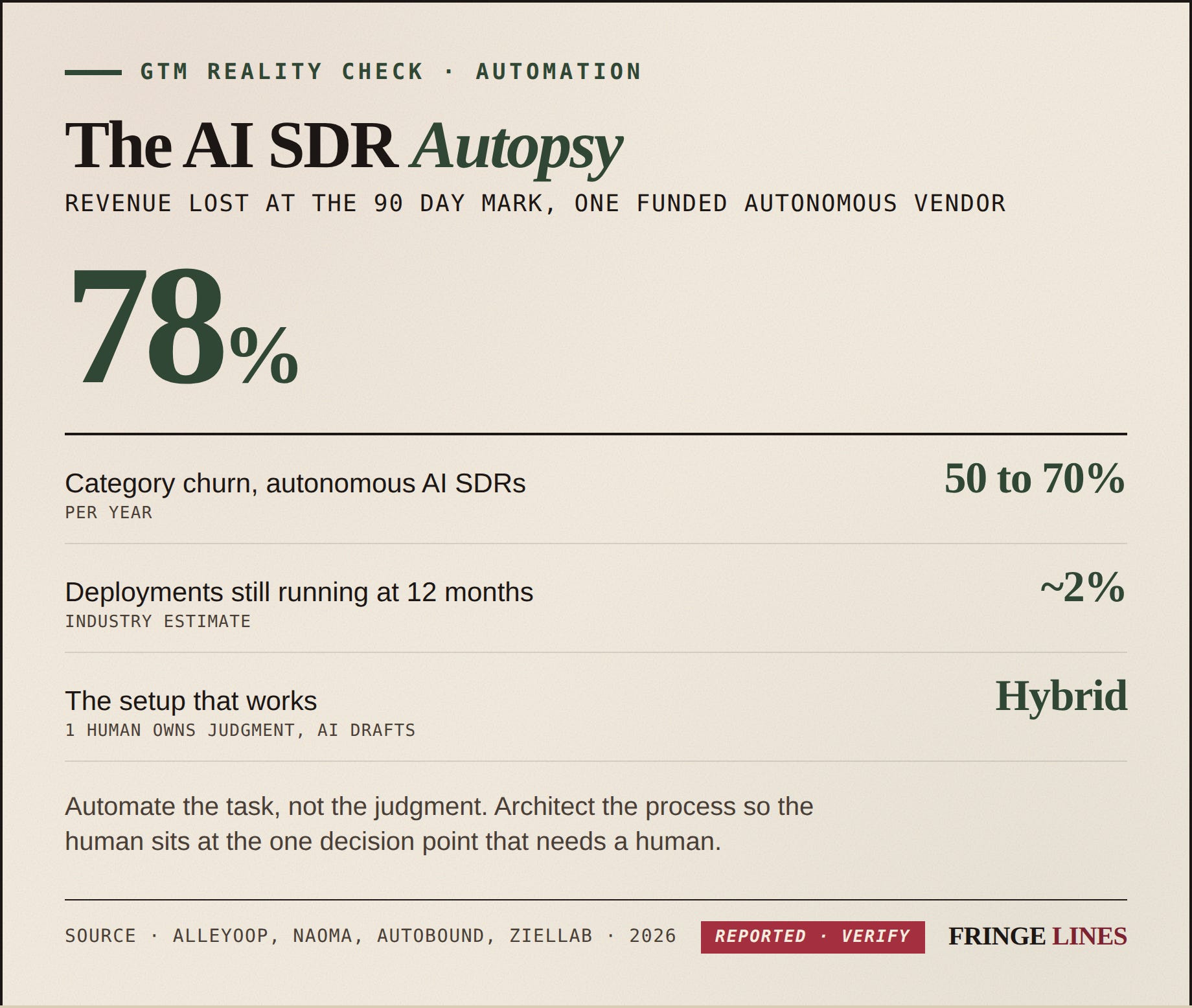
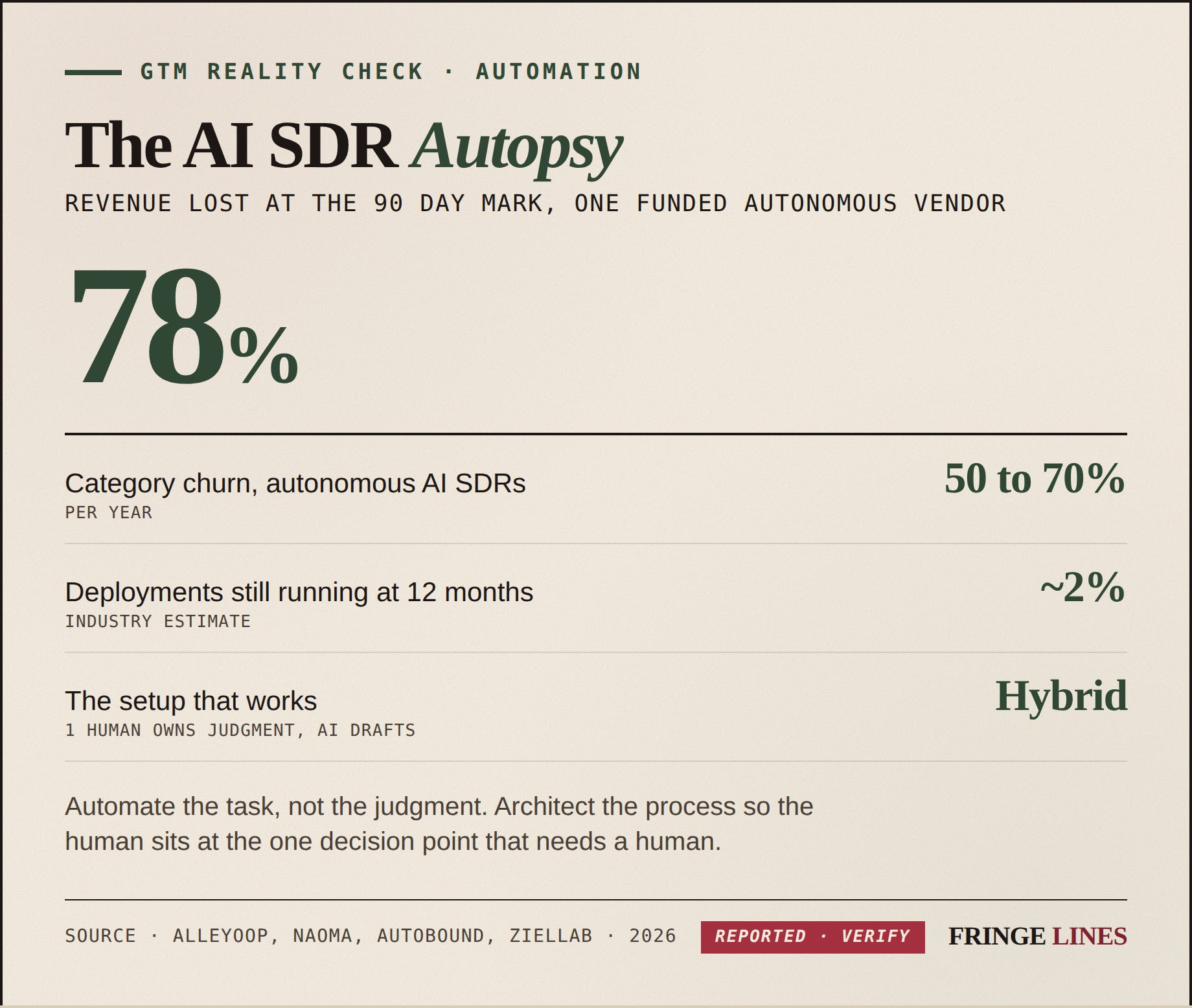
The pitch was clean: fire the SDRs, let agents prospect for pennies. The reality, based on reported figures circulating, was a glorious bloodbath. One heavily funded autonomous vendor watched most of its revenue evaporate at the 90-day mark, a reported 78 percent churn rate. Reply rates for AI-only outreach were in the low single digits, compared with a healthier human range. The cost per opportunity went the wrong direction once you accounted for the wreckage, reportedly climbing from the mid-hundreds into the low thousands.
The lesson is not “AI does not work in sales.” The lesson is architectural. You build the process around the human, so the human sits at the one decision point that requires a human, and the agent handles the pre-work and post-work. Automate the task, not the judgment. The companies that fully automate a bounded task win. The ones that get an agent 80 percent of the way through a nuanced job and call it done are the ones hemorrhaging ARR.
Salesforce quietly became the brain
Going headless, transcripts of every customer interaction, and large models may be what finally delivers the CRM brain we were promised decades ago. Pull in the real-world context, automate the data entry reps hate, feed the unstructured signals across systems- ticket data, product-led usage, churn flags, the stuff that never made it into a clean field- and the CRM stops being a database you resent and starts being the actual nervous system for the revenue org.
The AI assistant becomes the way you talk to the system, and the dashboards become live artifacts that refresh automatically. One of us already runs a fully automated weekly business review that pulls together website analytics, revenue data, Slack notes, and meeting transcripts into a single narrative with a single command. Two, the seat math changed. Jason Lemkin has talked about reducing his Salesforce seats to the three people who enter data, with everyone else on a read-only layer via the assistant. An API governance layer like MuleSoft is what lets the whole team see what one power user builds without buying everyone a full seat.
$9 billion dollars for babysitters - My kids’ futures are looking up!
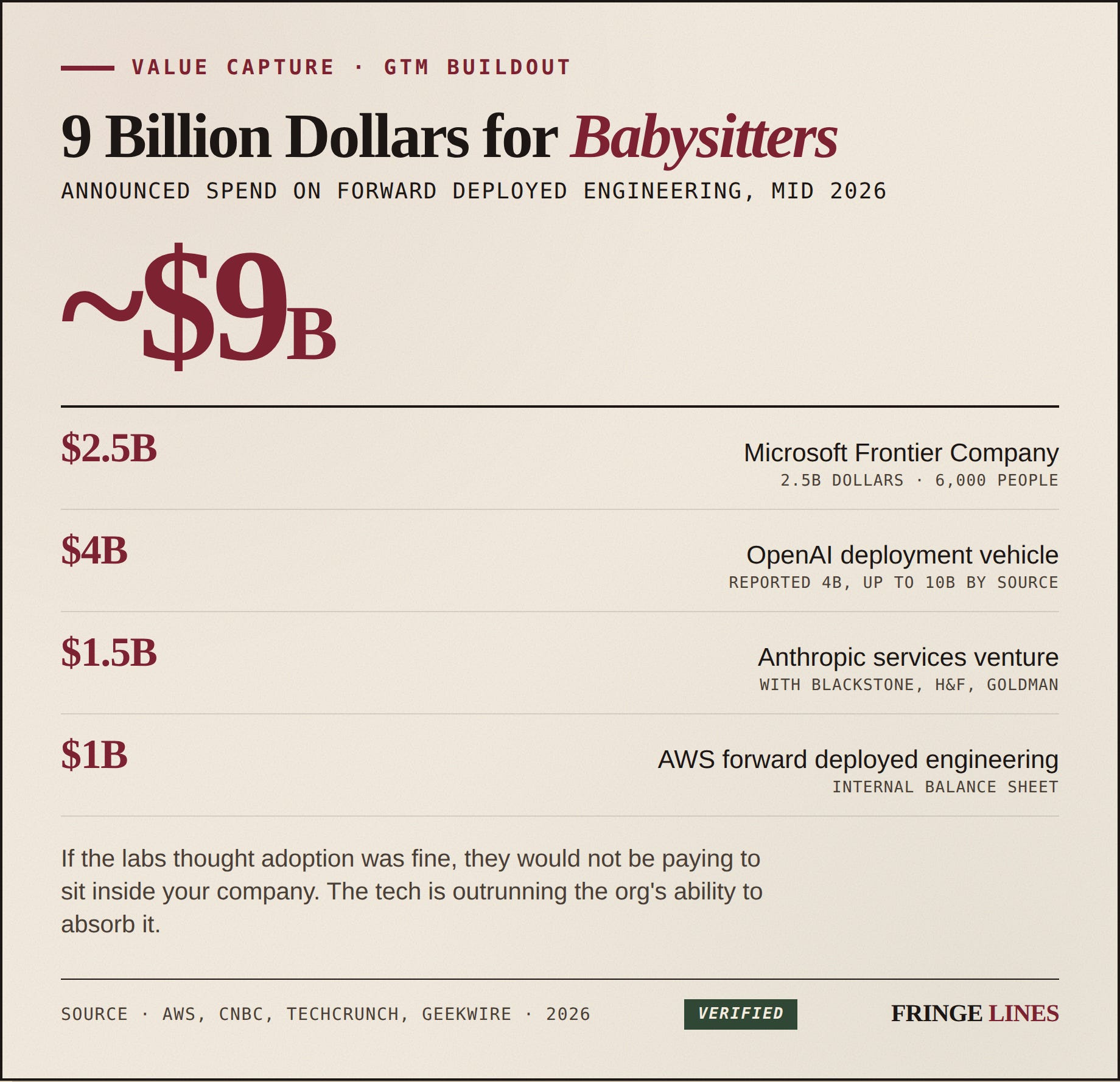
If the labs believed adoption was going fine, they would not be doing this.
If investing 100% of free cash flow in CAPEX wasn’t enough, the hyperscalers said, hold my beer. Amazon invested $ 1 billion in a forward-deployed engineering org. Microsoft answered two days later with 2.5 billion dollars and 6,000 people in a new unit called Frontier. Anthropic and OpenAI stood up their own deployment vehicles earlier, reportedly around 1.5 billion and 4 billion, respectively, though the OpenAI figure has been reported as high as 10 billion depending on the source. Add it up, and you land near 9 billion dollars aimed at one thing: sitting inside customer companies and dragging AI from pilot to production.
Read the signal from the noise, not the press release. This is the realization the tech is outrunning customers’ ability to implement it. Adoption is slower than the roadmap calls for; companies cannot figure it out on their own, so the industry is back to throwing human bodies at a change-management problem. That mirrors electricity in the early 1900s, when the factories had the power and still spent 20 years learning how to rewire the work around it.
We debated whether a forward-deployed engineer is just rebranded professional services? Partly, yeah. A true FDE builds features on-site that flow back into the core product for all customers. If the work does not make it back into the product, you hired an expensive consultant to implement a system. Both can be true: some of this is real platform-building, and a lot of it is consulting with a better logo.
The narrative flipped from fear to optimism
Watch what the labs stopped saying. The early playbook leaned on fear, the sky-is-falling framing that helped justify the CapEx and the raises. The blowback showed up on schedule: data center NIMBY fights, and a workforce asking why it should adopt the thing pitched as coming for its job.
Now the message is pivoting to optimism, the “it will not take all the jobs, it will cure cancer” register, closer to the tone that would have landed better from the start. Contrast that with China’s “this is for the collective good” framing and you see two opposite adoption strategies playing out in public. The marketing shifted because fear turned out to be a bad on-ramp for a technology that you need millions of people to willingly adopt.
Vibe code has a production problem
Demos and slideware are magic. Production is a different sport.
The gap is the undifferentiated heavy lifting: the CI/CD, the databases, the identity and access wiring that turns a weekend build into something a business can run on. Until the platforms swallow that scaffolding, most vibe-coded output stays a skunkworks project, not a product.
And the claim that “vibe coding democratizes software for everyone” is too strong. A healthcare firm is elite at healthcare because that is where it makes its money, not because it is secretly a software shop. The people moving to the frontier of software development will be better at software, same as always.
The barbell: headless on one end, taste on the other
The cleanest frame we saw all week came from the GTM writers: AI is barbelling go-to-market. One end is headless. Salesforce and HubSpot are already heading there, where agents run on the platform, or the platform runs your agents, with a UI still hanging around for the humans. The other end is taste.
When execution is easy, differentiation has to move somewhere, and it moves to the thing that cannot be copy-pasted. You can already spot the AI-built sites. That is a Claude site; that is a Gemini site; the same peanut-butter schema smeared across a thousand pages unless someone fed it a real style guide and real judgment. Taste, brand, and a point of view become the moat precisely because the model hands everyone identical raw output. Teams that can encode their design and style into the system, and orchestrate on top of these headless platforms, get the edge. Everyone else ships slop at scale.
Trust is the moat AI cannot fake
Growth is now a trust problem. When execution commoditizes, value migrates to what AI cannot fake, and buyers, flooded with AI slop, notice the brands that get it. We feel it ourselves as buyers, drowning in auto-generated updates nobody asked for.
So who captures the value when building is free? Not the model; the model is becoming a commodity input everyone rents. Not the skinny wrapper, maybe a substantial harness? We know value goes to firms that own distribution, whoever owns taste, and, above all, whoever owns trust, because those are the three assets a competitor cannot spin up in a weekend and a model cannot generate on demand.
People still buy from people they know, like, and trust. That was true before any of this, and it is the one moat that gets deeper, not shallower, even as the tools get better.
Be likable. Be trustworthy. Then go sell your stuff.