

It used to be that ideas were cheap and execution was hard. That equation is flipping fast — and what it means for enterprise sales, SaaS, and your career is worth paying attention to.
This week, we’re covering what we’re seeing on the ground: non-technical founders building entire back-office systems in a weekend, Goldman Sachs projections reshaping the SaaS TAM, why your customers want AI from vendors they already trust, and an open-source agent called Open Claw that might keep you up at night.
A Tree Guy Built His Own ERP in 40 Hours
A buddy who runs a tree service business — no coding experience whatsoever — sat down for a marathon weekend and built a full back-office ERP system. He started on Claude Desktop, hit the context window limits, moved to the web interface with multiple tabs, then discovered Claude Code. He paired it with Whisper for voice-to-text input and spent the last 15 hours of his build just talking to Claude Code. The result? A working system backed by Supabase.
Meanwhile, we deployed a fully automated image generation stack on AWS using Amazon Kiro — cloud formation deploys it, sets up all resources, and it parses rows from an Excel file as individual prompts, sends them to Amazon Nova Canvas, and saves the outputs to S3. Swap in your preferred image or video model and you’ve got a production content pipeline.
The takeaway that keeps echoing: execution is getting really easy. The idea might be the hard part now.
Marc Andreessen made a related point recently — Claude Code is amazing, and it was built in two weeks. But flip that around: it only took two weeks to build, which means competitors are right behind. Distribution is the moat, not the build.
AI Hasn’t Made Us Better Sellers Yet — But It’s Changing How We Work
Here’s an honest admission from the trenches of enterprise B2B sales: generative AI isn’t dramatically improving the selling motion yet. Not for account managers going deep on a handful of named accounts. It’s not the SDR-scaling, outbound-automating revolution that the hype cycle promised.
Where it is helping? The internal bureaucracy. The paperwork. The analysis you never had time to do.
One practical example: spinning up an internal Slack channel called “AI for BI” and just dumping Excel files into Claude. Prompting it with “pull out five interesting anecdotes from this data” and getting instant signals — stack-ranked insights with actionable suggestions. Would you have done that analysis manually? Probably not. Would it have required a formal request to your data team? Definitely.
Another example: a finance professional watched someone use Claude to generate a cash flow statement from a balance sheet and income statement. Work that would have cost thousands of dollars in consulting fees — done in minutes. And honestly? The consultant would have hated doing it.
The pattern emerging: AI isn’t replacing the selling. It’s eliminating the friction around it.
Your Customers Want AI From Their Existing Vendors
This might be the most important signal for GTM professionals right now. From the OnlyCFO 2026 budget analysis:
“I don’t want to purchase from another vendor. I have too many apps already. I want to purchase AI stuff from my existing vendors. I bought them because I trust them.”
If you’re an enterprise seller, this is your green light: lead with your existing customer relationships. Talk to your customers about your company’s AI offerings. Don’t put your customer success managers up against hungry, hyper-native AI startup reps in what feels like an entirely new sale — they will lose that fight.
Win where you have your moats. Start from your strengths.
And to the people predicting the death of SaaS — the reality is more nuanced. Nobody is ripping out a thousand-integration CRM like Salesforce to replace it with a vibe-coded internal tool. Most of the cost of software is in the maintenance, not the building. Compliance, updates, security — that’s where the money goes, and that’s not going away.
The Goldman Sachs TAM Projection That Should Get Your Attention
Goldman Sachs estimates the total addressable market for SaaS at roughly $30 billion today. By 2030, they project that shrinks by about a third to $20 billion. Sounds scary — until you see the other side of the ledger.
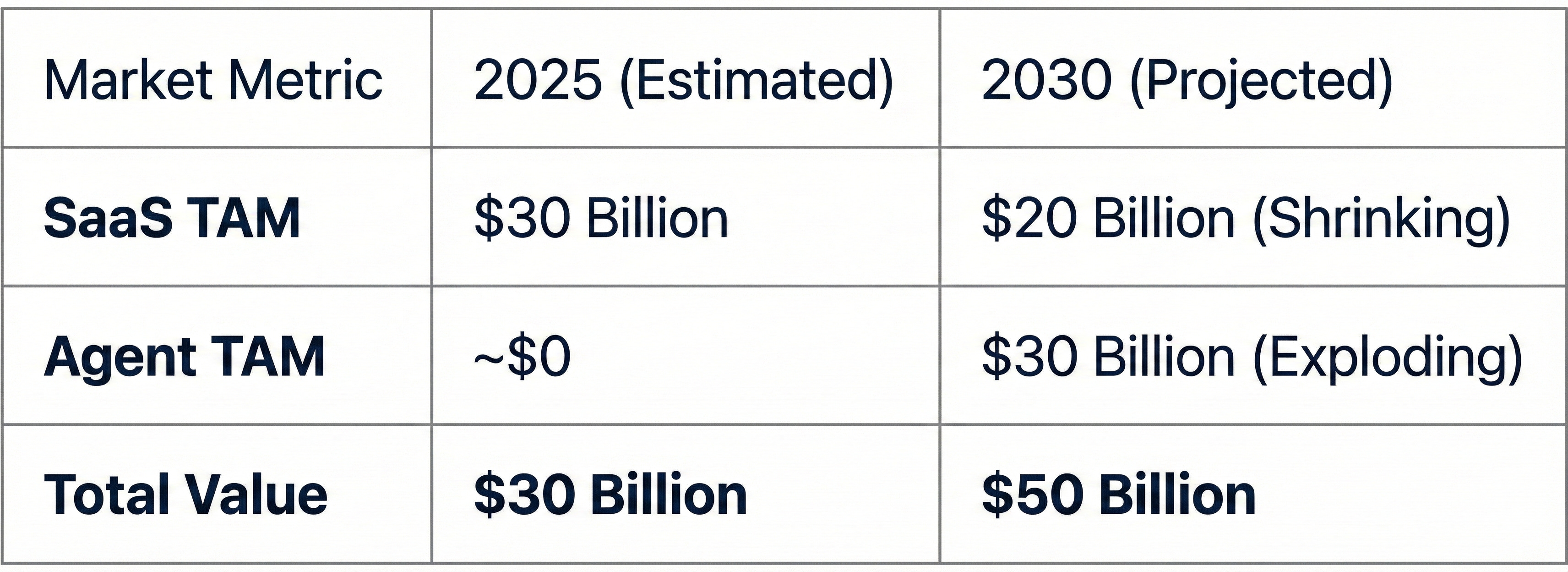
The agent TAM goes from essentially zero in 2026 to an estimated $30 billion by 2030. Add them together and the total market grows to $50 billion. There’s more value out there, not less. The nomenclature is shifting from seat-based licensing to outcome-based models, but the opportunity is expanding.
SaaS is under pressure — but perpetual licensing was supposed to be dead for years, and they still use on-prem Oracle databases. Don’t write the obituary yet.
One spicy take we heard: enterprise software won’t die, but Excel and PowerPoint will. Not in function — you’ll still work with tabular data and presentations — but in form. You’re not opening a spreadsheet and manually formatting columns anymore. You’re dropping the file into Claude and asking questions.
Open Claw: The Personal AI Agent That’s Both Exciting and Terrifying
Open Claw (formerly known by several other names before trademark issues intervened) is an open-source personal assistant that orchestrates AI agents. Here’s what makes it different from the enterprise agent frameworks like CrewAI, LangGraph, or Amazon Agent Strands:
It runs locally — even on an old Windows laptop or a Raspberry Pi
It connects to your model of choice via API
It communicates through a Discord server — you just message it and it works in the background
It gives you updates when tasks are complete
One person in our network has it running on a 10-year-old laptop, connected to Claude’s API, taking instructions through Discord. It does what you’d normally do in Claude Code — thinking, executing, iterating — but autonomously in the background.
The promise is enormous. The risk is real: people have been hacked after sharing API keys on public instances. Prompt injection remains a serious vulnerability if it’s exposed to the internet.
But here’s the thought experiment that keeps us up: if one person can run one Open Claw agent, why not two? Or five? You treat each one like a separate employee with its own credentials, workspace, and isolation. At that point, what does headcount even mean?
The scariest and most exciting question: if your Open Claw and my Open Claw can handle discovery calls, share architectural diagrams, break down infrastructure portfolios, and match up partner solutions — when do humans step back in? Probably at the $1 million signature line. But everything before that?
The Macro Backdrop: Revenue Per Employee and the Coming Squeeze
We’d be ignoring reality if we didn’t mention the broader context. Unemployment is at its highest since the Great Financial Crisis. Major tech companies — Amazon, Microsoft, Google — are all laying off. You can argue that’s COVID correction rather than AI displacement, but the structural shift underneath is real.
AI is deflationary for software. It’s easier and cheaper to build. The top decile AI companies are running average revenue per employee around $750,000. If your business model was built on the old P&L of high-margin seat-based software, you’re now competing against teams that do more with fewer people — and they’re going to push prices down to capture market share.
The optimistic view: once companies right-size their ratios and restructure their business models, there should be room to climb back up the value chain. More people should eventually equal more output and differentiation. But the transition period? That’s where we are now, and it’s going to be bumpy.
What We’re Watching
The AI GTM 100: A curated list of the top AI-powered GTM tools. Clay remains the only unicorn (valued over $1B). We’re tracking names like Air Ops (generative engine optimization), Attio ($116M raised, CRM play), and Unify (outbound automation). The question: are we entering the age of “lifestyle SaaS” where it’s so easy to build that you don’t need to be a $10M+ company?
Content generation pipelines: We deployed a system using n8n that scrapes a fashion catalog, pulls all product images, and generates 8-second model videos using Google’s Veo 3.1 — all within an hour. Gamma Studio just upgraded, and the gap between “I had an idea for marketing content” and “here’s the finished asset” is collapsing.
Product-led growth ceilings: Anthropic’s growth is remarkable — people are just requesting seats organically, no AE required. But remember Andy Jassy’s reflection: “I wish I had hired an enterprise sales team sooner.” PLG has a ceiling. Even rocket ships eventually need account executives.
The Bottom Line
If you’re in GTM, the message is clear: build, experiment, and protect your existing customer relationships. The tools are absurdly powerful. The competitive landscape is shifting fast. And the value — both the TAM projections and the day-to-day efficiency gains — is real, even if the perfect AI-native sales motion hasn’t been figured out yet.
Nobody’s cracked the code on AI for enterprise B2B sales. That’s not a problem — that’s an opportunity.
Until next week — keep building, keep selling, and keep asking Claude, ChatGPT, and Gemini the questions you’d never have time to research yourself.