

The popular LinkedIn infographics put the go-to-market stack somewhere between 27 and 35 tools. Doom went down his own list on air and got to Salesforce wired through MCP into ClickHouse, Vercel, Google Sheets, Sales Navigator, and Apollo when a batch of leads needs enriching. Three or four core, he said. Quinn’s theory about the person running all 35: they don’t exist; they just asked Claude Code to make the infographic.
What those three or four tools did this week is the more interesting number. Doom pulled every customer’s revenue against their API consumption, modeled what a consumption charge would recover, and drafted the business case behind it, in five minutes. Quinn rebuilt an executive briefing agenda for two new cities, work he says would have taken weeks and probably never happened.
Listen now: Spotify · Apple Podcasts · YouTube
Three ideas from the episode
1. The 30-tool GTM stack is a LinkedIn artifact, not a job. Quinn walked Adam GTM’s category map: traditional SaaS going headless, AI-native challengers, coding harnesses, orchestrators, GTM tools, and AEO marketing tech. Six categories, with the same names repeating inside them. Doom’s honest daily count is three to four, and neither host could name a real person running the full set.
2. Doom found roughly $350,000 in five minutes. Some customers were consuming more API than they generated in swap fees, which put the margin underwater. He asked Claude to pull revenue against consumption per customer, model what a consumption charge would recover, then write the PRD for turning it into a product. The old version of that work meant writing the queries himself, pulling the consumption, and matching it against billing by hand.
3. Output per person went up. Revenue and headcount did not follow automatically. Quinn’s line: token budgets aren’t unlimited, and headcount budgets aren’t unlimited either. If the storage isn’t selling faster, more productive reps don’t justify more reps, they justify reallocating the ones you have. The outside number he brought to it, from a McKinsey CMO on a Forbes panel: only 7% of companies have scaled AI across the business, and every AI dollar needs 3 to 5x behind it in change management.
Key takeaways
Lightly edited for clarity.
How many tools does it actually take to run a GTM org?
Quinn: We’ve been joking, how many tools do you need to run a GTM org? Like, how many people do you need to screw in a light bulb? I think our consensus is between 27 and 35, based on all the infographics on LinkedIn.
I’m a big fan of AdamGTM.com. He posts a lot, and he does a lot of pulling together of data and curating it, which I thought was really interesting. He basically looked at the different categories and the GTM players in each category. You’ve got traditional SaaS going headless, I think of CRM. You’ve got your AI-native GTM challengers, Attio comes to mind. Your coding harnesses: Cowork, Claude Code, Cursor, Codex. I think he’s got Lovable and Replit in there too. Your orchestrators: n8n, Zapier, Make, and Clay, which I didn’t realize does a lot of workflows. Then GTM tools, and AEO, the AI search engine marketing tech, which I’m not as familiar with. This is Semrush, I think.
But this is pretty manageable. Six categories. And then you see some names repeating in here.
Doom: Of the brand names we know, I still just... Maybe we should do this as one of our future interviews. We need to find this GTM guy who uses all these.
Quinn: I don’t think they exist. They just ask Claude Code to create an infographic to use them.
So what’s actually in the stack on a normal day?
Doom: I’ve got Salesforce. We have our MCP, so Salesforce, which taps into ClickHouse, which is where the data sits. And Vercel, so I could spin something up and push it to Vercel. What else am I using? Google Sheets, to push out the proposals.
Quinn: Four.
Doom: And then I have LinkedIn Sales Navigator, and on occasion Apollo for data enrichment, but that’s not a daily tool. I’m not enriching leads on the daily. It’s, “oh, hey, here’s a batch.” So I’d say three to four core.
Then they have Lovable in there. What GTM engineer is using Lovable? Is he just spinning up POCs and being like, “here’s what it looks like”? And I would say, well, why aren’t you just using Claude Code?
Quinn: I always hear people using Lovable as their prototyping engine, and then maybe that generates the initial design, and then they go use Claude Code. So it’s a quick MVP-ish prototype. That’s what I’m hearing most.
For me, I know I’m not a full GTM stack guy, just because I work at a large company day to day. We use Salesforce, and most Fortune 500 are Salesforce customers. Then I use Quick, which is kind of our Claude Cowork, just the desktop interaction, because it has all the MCP servers. And obviously Excel, PowerPoint, Salesforce.
Because we’re not in a transactional business, everything’s usage-based, it’s a little bit of a disconnect. We can’t track all our revenue all the way in Salesforce. I’m sure Azure and GCP and any usage-based company is the same, versus, oh, you signed a contract for a million dollars, this many seats. You know what you’re gonna bill the next 12 months. That would be a lot easier and cleaner.
What did an agent actually do for you this week?
Quinn: I rely a lot on our MCP servers into the different systems, with our phone tools. I took an EBC agenda, the topics, and I said, okay, take this, that worked well. If I wanted to do it in Washington, D.C., what could I do? So it went and checked all the phone tools, found comparable people, and asked which ones I wanted to swap.
I was like, okay, well, we don’t have security, but we have compliance. We don’t have this, but we have public sector and FedRAMP. And then New York had a little bit more of a fin serv twist on it. So I shipped that out to my team, because we’re already talking about doing another EBC next year.
Dude, that would’ve taken me fricking weeks. I don’t know if I ever would’ve done it, and then it would’ve just been team calls and wasted time and a lot of non-answers. And boop, these people are real, the topic’s real, an agenda, something to actually discuss. It was clutch.
Doom: That is sick. And maybe not applicable to those who don’t understand phone tool, or having to go through and hunt that down. But that is pretty awesome, that it automated the whole thing off your natural language, where you hit the audio transcribe and say, “hey, go do this for me.” Being able to pull that off is pretty amazing.
If a rep can build the forecast himself, how many specialists do you need?
Doom: I wanna touch on your specialist one. The fact that you were able to bring the forecast to her, and before, they’d be like, “oh, well, we can do this,” and you’re like, “oh, I already have it done.” Not to say you’re replacing her job, but then the question is, do they need more of her? How many specialists can they scale down now that you have specialist ability at your fingertips? You still need the specialists, but now you don’t need 10 on staff, because they’re not spending the cycles building those forecasts. Historically, you and three others might come to her in the same week and be like, “hey, can you run a forecast for these?” And she’s working on three different forecasts.
Quinn: It’s a great question. This is where I’m super biased, because Excel has always been pretty easy for me. Granted, they are lightweight Excels. I’m not a financial analyst, I’m not building fancy models with macros. But something linear, or just some key assumptions. I was always surprised how many people struggle with that in our roles as reps.
The main reason I reached out to her is I needed a gut check on whether 40 or 50 petabytes is meaningful to the service team. Because if it is, then I wanna shore up my executive relationships, and what I need is her connection to the service line leaders and her understanding of their priorities and opportunity sizes. So the forecast was not the most value she’s gonna bring. Could she scale out? I think so. Or maybe she can invest more time with other customers. With some specialists there’s always been an interesting balance, where it’s, oh, I only cover 100 customers, or 50, because I can’t scale out. Overall I think it’s more augmenting the work so that we can do more.
Doom: So you can do more, and then you don’t need to hire more headcount. I wonder, now I’m doing the work of what would typically take three. You go hire another version of me, and they can do three. But is there that much demand? Using the AE as the supply side, you’re able to handle this work, but if the demand’s not there... I guess you reach the equilibrium, and you realize where the fat is, and then you cut from there.
Quinn: Or you might have the challenge that your output per person has gone up for that scope, but you’re not selling more storage, so why would I hire more people? If you have all these more productive people, then either you don’t hire as much, or you reallocate your people to what they should be focusing on, so it’s more value-add activities to drive the revenue. Just like token budgets aren’t unlimited, headcount budgets aren’t unlimited either. If you’re not growing revenue faster, then why are we investing more in the inputs? That’s a race to the bottom.
What happens when customers consume more than they pay you?
Doom: We have some users who are consuming more than we’re earning on API requests. If you’re consuming our API, our workload is combined in that request, so there’s a cost to that. But we generate revenue off of, let’s call them swap fees, so it’s volume. If we’re not doing that, then we’re subsidizing all the requests coming in above and beyond what we make off of you. So we have a negative profit margin.
Literally this week I went into Claude, because I was like, I need to solve this. “Hey Claude, pull me a list of all of our customers, and tell me their revenue generation to consumption, what that looks like.” And then my follow-up: “Based on this, if we were to charge a consumption model on the API requests at X amount, what would that revenue look like to help us offset?” For people who aren’t consuming, they have their default, and anything your revenue doesn’t cover, you cover through a consumption model. What does that revenue look like? Call it an additional 350,000.
Then I was like, “Help me write the business use case, and basically the PRD for this, of why we should turn this into a subscription-based product consumption model, in addition to our current plans.” That’s something in the past that would’ve taken me forever, because I’d have to go write the queries, pull all the consumption, look at what they were billing, match that up. Did it in five minutes.
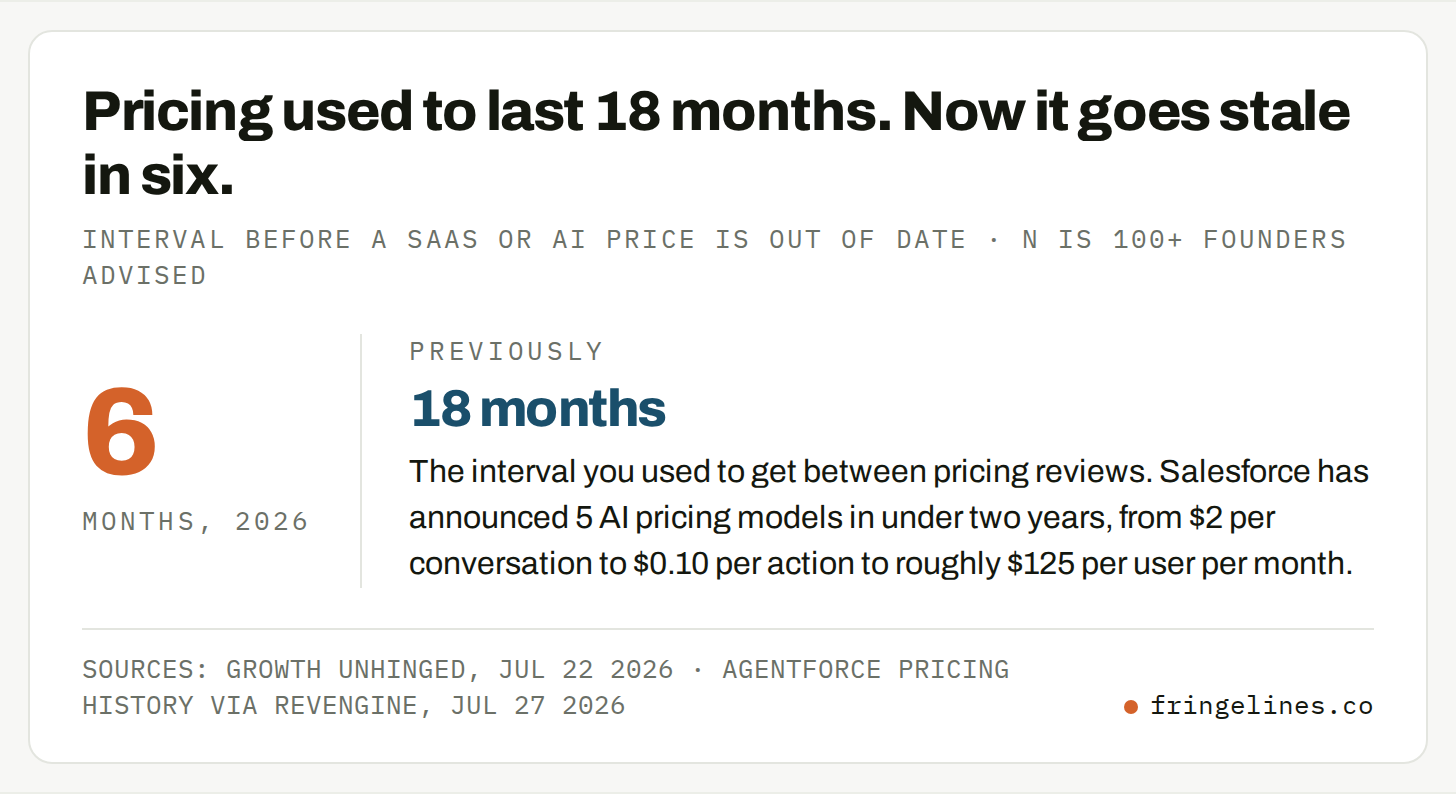
Quinn: Dang, dude. You should check out Growth Unhinged. I didn’t read this, because I’m not in pricing, but pricing used to last 18 months, now it’s down to six. It’s so crazy. We use Descript, and they switched to the credit model, and I’ll get the alerts halfway through the month: “oh, you’re over 50%, do you wanna top up?” And I haven’t had to yet. I’ll pay for it, because it’s worth it, because that means I’m editing more content. It’s interesting that it’s going this way. You have usage-based and less seat-based. It’s a new paradigm. I don’t know where the moats are gonna be.
Doom: I’m probably biased, but consumption is the smartest way for the companies. And I don’t know if users understand it. A lot of times they think, oh, it’s only 30 bucks per 100 requests, or whatever it is. That’s fine, that’s much better than paying $300 a month for a seat. But then they end up paying $750 for everything they’re consuming. So it’s play at your own risk, read the fine print. You can’t fault the company for doing it, because at the same time, if you’re consuming that much, you should probably be paying for it.
The summer of CLIs
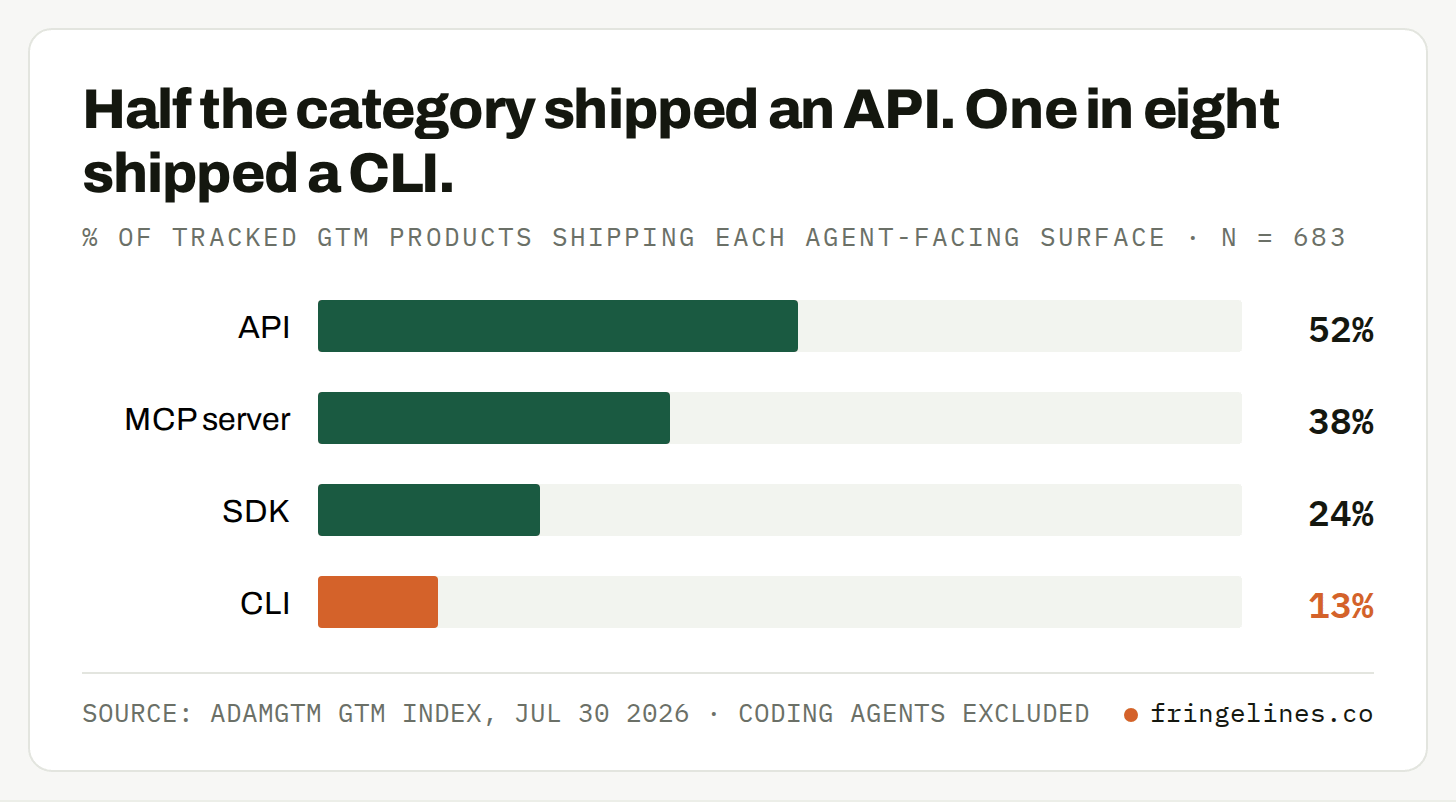
Quinn: Back to Adam. He was calling out a trend around usage: the summer of CLIs, command line interfaces for go-to-market. These go-to-market builders using Clay and Apollo and ZoomInfo, and then you’ve got HubSpot and Salesforce. There’s been this whole shift in Q2 of 2026. Instead of relying predominantly on the web interface, going to log in and do the work, there’s been this shift to GTM non-technical, quote unquote, which at this point I don’t even know what you consider non-technical if you’re building websites and putting them on Cloudflare. Is the bar for non-technical gone up or down?
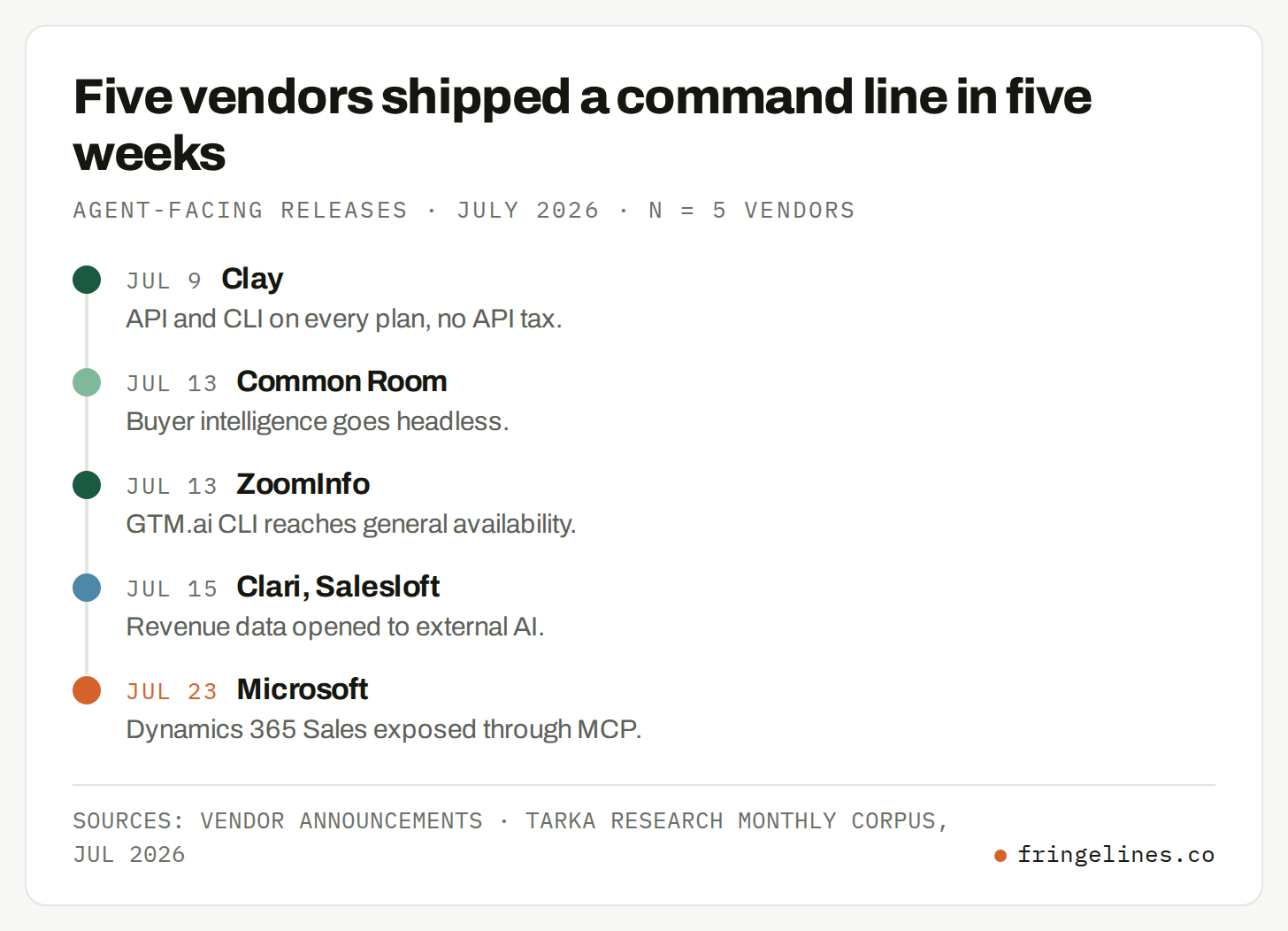
What I found with MCP connectors, model context protocol, is that it’s highly inefficient with tokens. It’s very chatty and it burns through things. And now with this whole pendulum swinging back on cost optimization, what is the output we’re getting? CLIs have been around forever. GCP has a CLI, AWS has a CLI, Azure has CLIs. You can just download and install your Clay or Apollo or HubSpot or Salesforce, open a terminal, and call the functions. Give me all the leads. And if you’re using Codex or Claude Code in the terminal, they can use the CLI. So it’s essentially a version of going headless, allowing these large language models to run all the queries on top of it.
In some sense it’s kinda scary, because you could be disintermediated by Codex or Claude Code. I’m not using Clay directly, and so Clay’s like, “well, who owns the customer?” You still have to have a Clay account. But the hypothesis here was there’s so much more unmet demand if we can sell essentially to the agents of GTM engineers, because they’re using and building agents. We need to allow them to consume our services faster and at a higher scale.
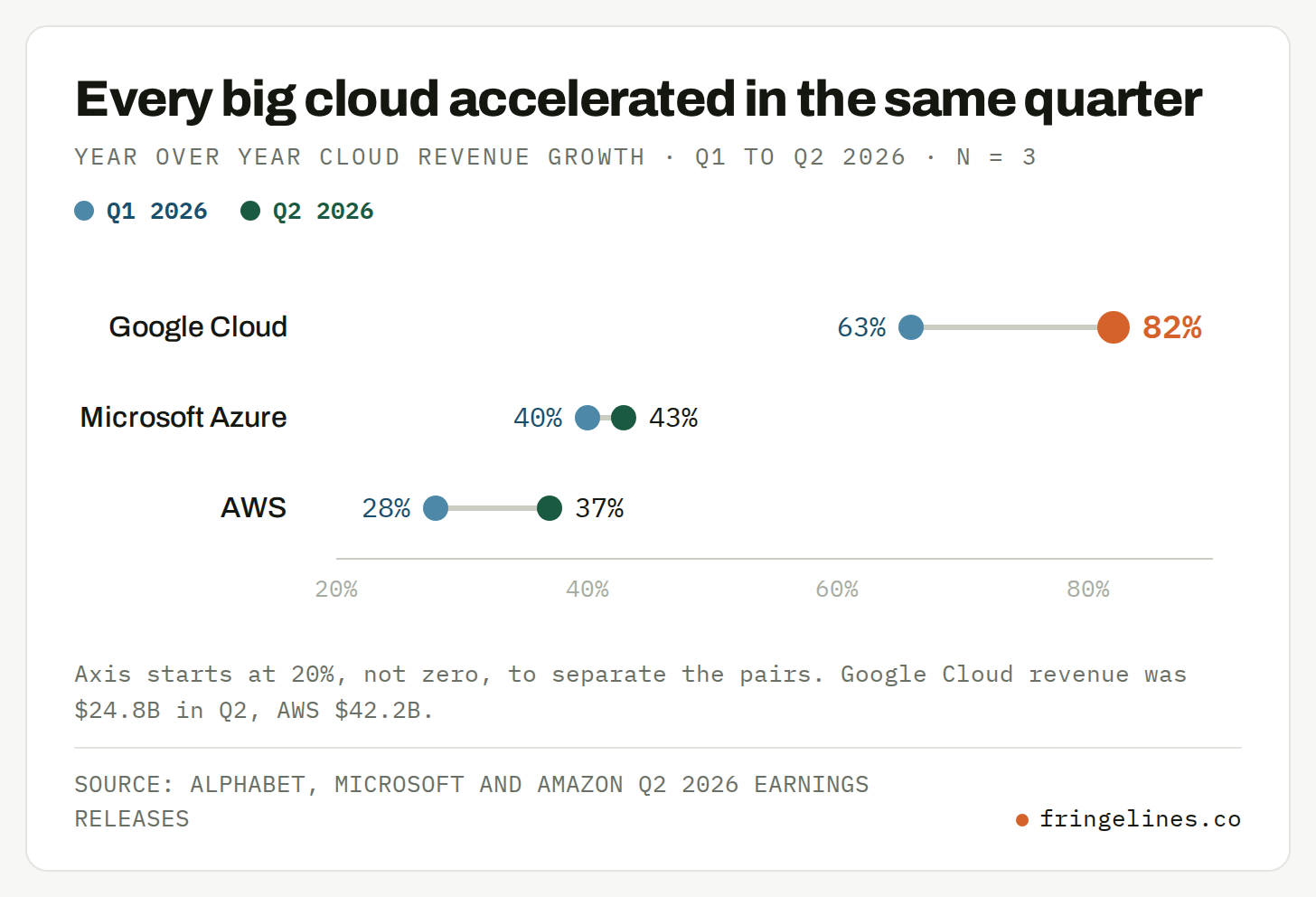
We just saw the quarterly results of Amazon, Azure, and GCP. Sick blowouts on the picks and shovels of the hyperscalers. So what happens in the second half? Are we gonna see a dramatic increase in usage, and maybe a shift of mix from seat to credits? This seems like a big pivot for GTM.
Should anyone be measuring the ROI of AI right now?
Quinn: Jensen said something, and it’s a weird concept. He’s saying if your CEO is measuring the ROI of AI, get a new CEO. And everyone’s talking their own book, so you gotta take it with a grain of salt. But we’re in the learning phase. You can see the promise of the technology is so great that in two years we can’t even fathom what we’ll be able to do with it. It’s hard to say where the value capture is. So if you’re trying to get a short-term ROI, you’re dumb. That was kind of the hypothesis.
The adage used to be, don’t build it and hope they come. Then it was, no, find your market, find your fit, then build it. So now we’re in this weird pendulum where all these GTM engineers are building more and spending more, but if everyone’s doing it, or you don’t figure out your niche enough, there’s only the same amount of customers out there, in my mind. You can spend more money and not grow revenue at the same pace as your expenses. Happens all the time.
So you really have to take a step back and holistically look at this stuff. I still hear these horror stories of people just defaulting to the smartest model. It’s not even that you shouldn’t be using LLMs this much, it’s that you need the model routers, the prompt evaluations, and the budget checks, to make sure you’re not just driving a Ferrari to the grocery store and then hitting potholes.
Doom: Or you just have all those, what was it? Jess used to say the zombie servers running under your desk. Or even in your AWS account, you’ve got all these EC2s that are just running that you’re paying for.
Only 7% of companies have scaled AI
Quinn: Forbes had this panel in Cannes, which apparently was a while ago, but it got promoted on my LinkedIn feed. The panelist I liked the most was the CMO of McKinsey, and he works with customers and he’s a CMO, so he dogfoods what he sells, which is always a great position to hear from and learn from.
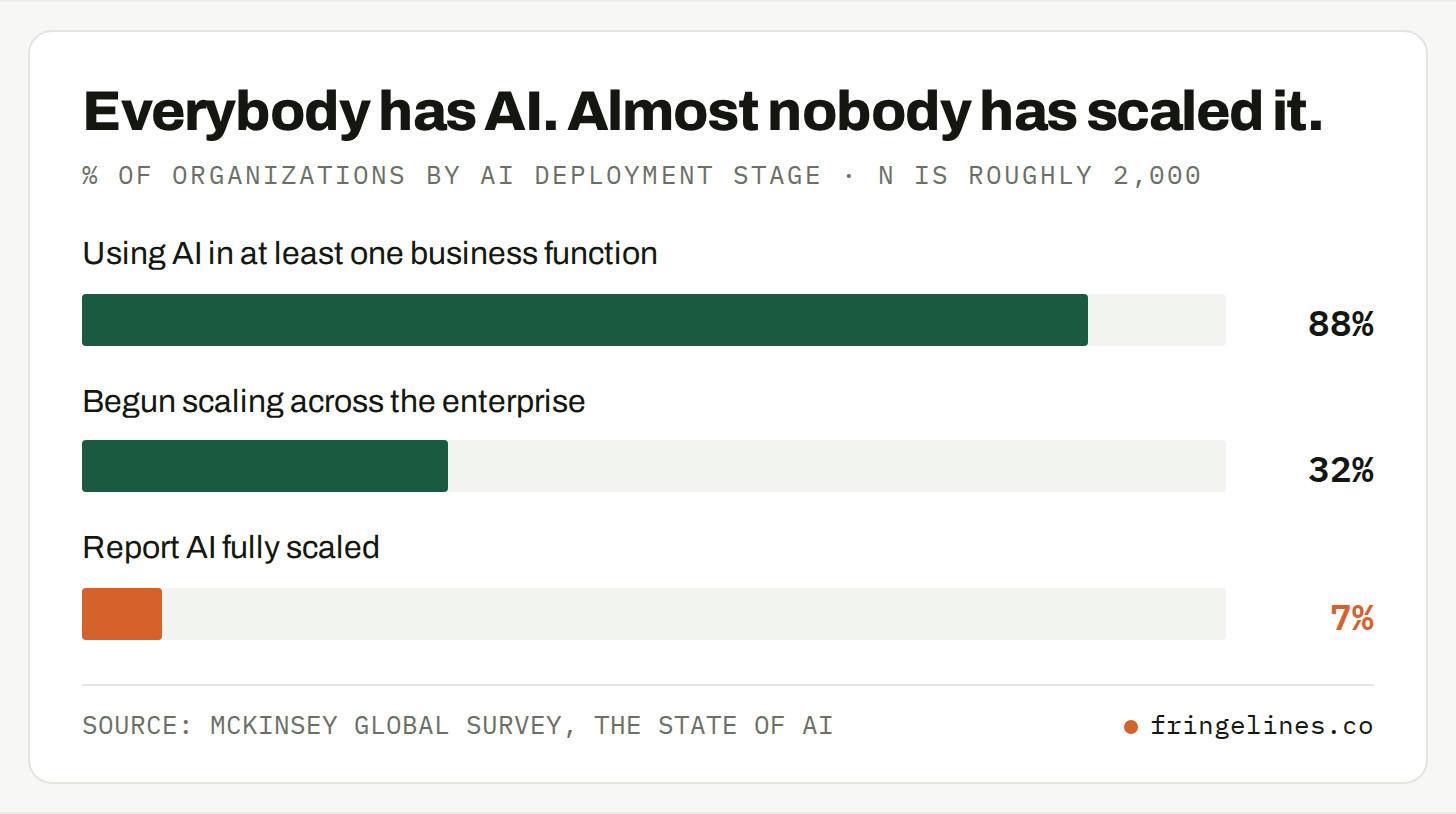
One of the things that stood out was the 7%. Only 7% of companies have scaled AI across their business, so there’s still a tremendous amount of opportunity here. Change management: for every AI dollar spent, you’re gonna have to spend 3 to 5x on change management, enablement, process changes. Faster and better, not cheaper, is the Uber story. Data readiness, which has been around forever, you gotta have clean data governance or you can’t get anything out of it. And if you’re gonna run a GenAI pilot, kill it in two to four weeks if it doesn’t work, which I thought was actually pretty good. If you can’t figure it out, then just iterate and move on.
Then growth, not cuts. I think this is the big one. The cost savings case is the easiest to approve and the smallest available, so if you’re just focused on cost cutting, then you’re probably gonna lose to somebody who’s thinking bigger. And they’re saying this really needs to be led by business, not IT. It just feels very deja vu, like every technology shift before. It’s different but the same.
Doom: What’s, uh, history doesn’t repeat itself, or history doesn’t... What is that?
Quinn: Those who don’t know history are destined to repeat it.
Doom: Well, that too, but like history doesn’t rhyme, but... I don’t know.
Quinn: History doesn’t repeat, but it... I think it’s something like that.
The missing interface is taste
Quinn: I don’t know if it’s the next wave, but what needs to happen is we need a better way to give agents feedback. You need a better interface, at least for visualizations, for conveying the taste component. Everybody’s talking about the barbell. It’s taste and build, right? You can build really fast, but if it all looks the same... So really the curated, what’s your ICP and what problems are you solving, around taste. It just feels like there’s a jagged edge in how I give feedback so it’s more personable to what I want visually.
If you have 1,000 agents working for you, how are you managing them? You have agents evaluating other agents’ quality, but when it comes to human taste, how do you give that feedback in that direction? That seems like it’s missing, and I just feel like that’s gonna be coming out in the next 12 to 18 months.
Doom: If not already worked on inside OpenAI and Anthropic. They’re already playing with it internally.
Quinn: I know. You remember when re:Invent used to be, “what companies are gonna get killed this re:Invent,” because a new feature got announced? It’s interesting, everybody Anthropic and OpenAI have partnered with isn’t a great partnership anymore. Apple with OpenAI, Figma with Anthropic and Claude Design. I don’t know, man. It’s partner at your peril.
Should you reverse engineer the apps you pay for?
Doom: There was somebody this week, it got a bunch of likes, and even somebody reposting it got a bunch of likes. They were open sourcing some skill that basically was like, you can go in and reverse engineer Whoop. Whoop is my band. Reverse engineer different apps like that, that people use. And people are like, “yeah, this is great, these companies are gonna die, this is great that we can do this.”
In my mind, I’m like, I don’t wanna reverse engineer Whoop, because I like it where it’s at now, and I expect that in a week or two they’re gonna ship me some updates. I’m not gonna go and ship myself updates. And yes, I think there’s maybe cool product features, but I would rather send that to them than try to continually iterate my Whoop and manage it myself. It goes back to the oil changing analogy. It’s great, I could change my oil. I could reverse engineer and build my own Whoop software. But I don’t want to.
Quinn: I agree, and it also misses something that’s obvious once you think about it, because everyone focuses on how I can recreate what I’m using in Whoop today. They never focus on what features Whoop is building that you’re not thinking about. If I see a door, it’s like, yeah, I have a door, I’ll make another door. But when you’re coming up with the design for the door, you can’t copy it, because it doesn’t exist yet. And when you have teams of tens and hundreds collecting feedback from all the different customers to build a better product, you’re not getting that.
So essentially what you’re saying is I’m just signing up to copy Whoop forever. For every app that I have, I’m just gonna build and copy their apps. You’re not looking around corners. Theoretically you should have a day job, and not be making your income by saving money on subscriptions for two bucks a month or 10 bucks a month.
Doom: Exactly. And your feature parity is where it is today. It’s not where it will be in six months, or even next week when they release the new feature and you’re like, “oh.” Like I said, I don’t have the time or the energy that I wanna spend managing building my own Whoop.